NetSuite Inventory Management:
Right Stock, Right Place, Right Time
Too much inventory ties up capital. Too little creates stockouts and lost sales. NetSuite Inventory Management gives you the real-time, multi-location visibility to get the balance right, with demand-driven replenishment that works automatically.
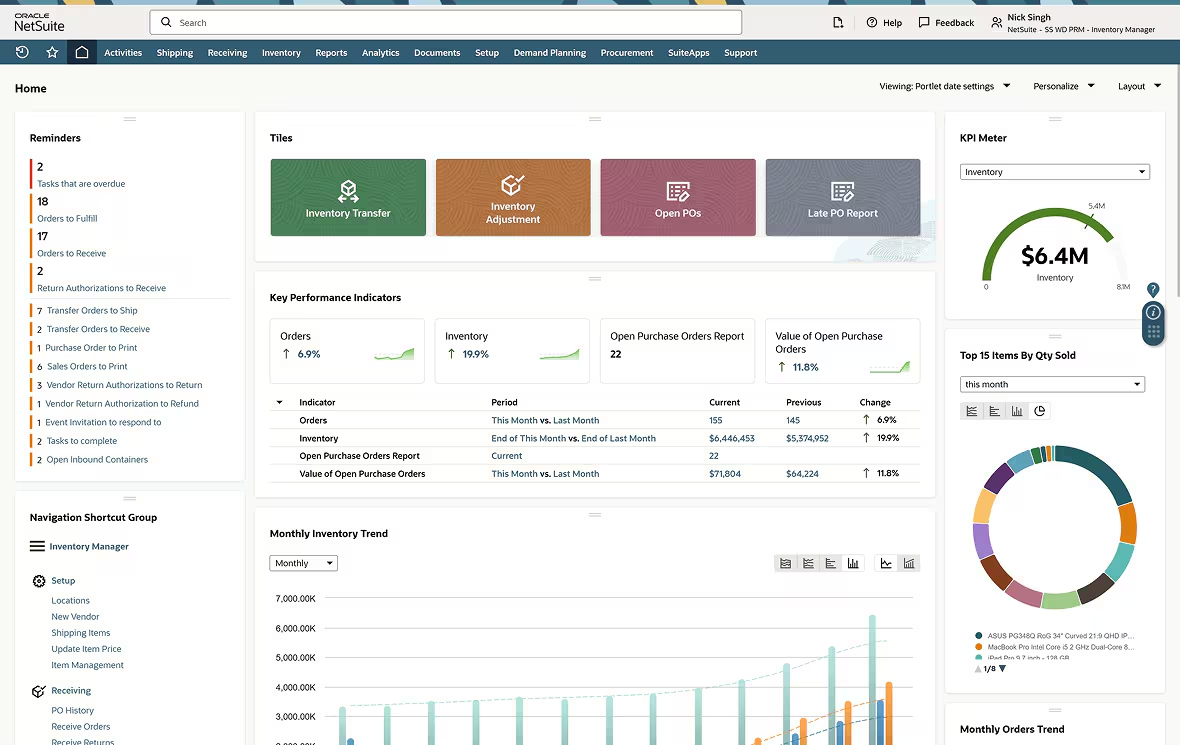
NetSuite Inventory Management Across Locations and Channels
What is NetSuite Inventory Management?
Inventory is working capital, and most companies are holding too much of the wrong things and too little of the right ones. The problem is almost always the same. The data isn’t current, it’s not consolidated across locations and replenishment decisions are based on gut feel rather than actual demand signals. NetSuite Inventory Management fixes that.
Real-time stock levels across all warehouses, channels and subsidiaries. Demand-driven replenishment that calculates reorder points automatically from historical sales, seasonality and lead times. Full traceability from procurement to customer delivery. And the Item 360 dashboard that shows everything you need to know about a product in one view, no cross-referencing required.
The Inventory Challenges NetSuite Solves
Excess stock, stockouts, and a lack of inventory transparency don’t have to be part of growing your business. NetSuite provides real-time inventory visibility across all locations, enabling faster, more confident decision-making and improved capital efficiency. Intelligent replenishment and optimised fulfilment rules ensure stock is available where and when it’s needed while keeping costs under control. With end-to-end traceability and automated processes, businesses gain full control, accuracy, and compliance across their entire inventory lifecycle.


What Improves with NetSuite Inventory Management
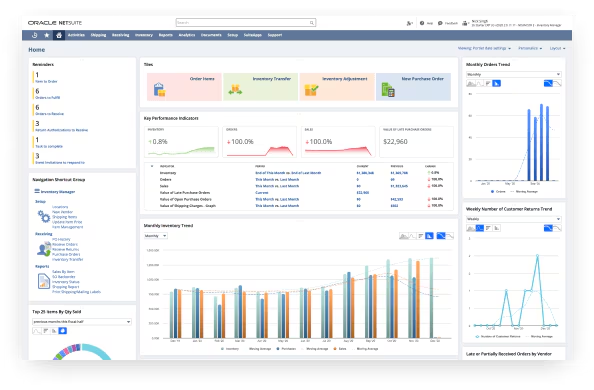
NetSuite Inventory Management in action
Central functions at a glance
We seamlessly connect your relevant systems
Cloudmaven offers flexible integration options to existing systems such as SAP, Microsoft Dynamics, HubSpot, Workday, Perk as well as to banks, payment providers and specialised finance tools.
- HubSpot
- NetSuite
- Workday
- Perk
Cloudmaven & NetSuite
As a NetSuite partner, Cloudmaven supports companies with the introduction, adaptation and further development of the platform. We design and configure NetSuite to fit your business model, not the other way around and ensuring a scalable architecture that meets international compliance and reporting requirements without adding unnecessary complexity.
Our consultants and developers combine deep NetSuite expertise with a clear understanding of the real challenges faced by CFOs, finance teams, and operations leaders. This allows us to deliver solutions that are not only technically sound, but also practical and effective in day-to-day operations.
- NetSuite Licensing
- NetSuite Implementation & SuiteSuccess
- Change Management
- Localisation and Global Expansion
- Support
one contract and one partner
Our services
Companies that already rely on our portfolio















Customer Testimonials

Svenja Frankenberger
Head of Accounting, Qualifyze
Revenue recognition used to take an employee five working days.
With NetSuite, it is now 100% automated.

Richard Gausch
CFO, TEVEO GmbH
Cloudmaven supports us on our growth path. Teveo was launched in 2019 by two founders and has since grown to over 100 dedicated team members, with sales increasing from zero to over 50 million euros. We are delighted to be advised by Cloudmaven AG with their ERP and financial expertise.
Martin Hoffmann
former CFO and Co-CEO, ON
This tool is so valuable to us that its benefits can hardly be expressed in figures. It saves an enormous amount of time and energy and, in financial terms, represents precisely the freedom we want to give our employees in their day-to-day work.

Jan Christopher Stahl
CEO, TEVEO GmbH
We chose Cloudmaven AG because their reliable end-to-end solutions enable us to develop our company securely, precisely and scalably.
FAQs
What’s the difference between NetSuite Inventory Management and NetSuite WMS?
Inventory Management is about planning and visibility, covering stock levels, replenishment, demand forecasting, traceability and multi-location management. WMS is about physical warehouse operations, such as guided picking, RF scanning, putaway strategies and task management on the warehouse floor. They’re complementary, many clients run both. The right combination depends on your operational complexity.
Can NetSuite Inventory Management handle seasonal demand?
Yes, seasonality is one of the built-in variables in reorder point calculation. NetSuite uses historical sales patterns, including seasonal peaks, alongside current lead times and target stock days to calculate appropriate reorder quantities. You can also override these for specific items or periods.
Does it support FIFO and FEFO fulfilment?
Both FIFO (first in, first out) and FEFO (first expired, first out) are supported natively, along with LIFO. The fulfilment strategy is configured at the item level. For lot-tracked or date-sensitive items, FEFO ensures the oldest stock ships first, without manual intervention.
How does the Item 360 dashboard work?
Item 360 is a single view that consolidates everything relevant to a specific item, such as current stock by location, open purchase orders, sales orders, reorder status, cost history and KPIs. It’s designed to give buyers, planners and operations managers the full picture without cross-referencing reports.
Discover the NetSuite Modules
Financial Management
The NetSuite Finance module forms the financial backbone of the ERP software for your company. It covers all central tasks, from accounting and reporting to compliance with international regulatory requirements.
Financial data is available in real time and creates full transparency about the company’s economic situation. This allows financial statements to be prepared more quickly, risks to be identified at an early stage and well-founded decisions to be made with confidence.
Global Business Management with OneWorld
NetSuite offers a central platform for managing international business structures. Companies manage locations and companies across national borders in one system.
This also includes international tax, currency and regulatory requirements.
Global processes are standardised and local peculiarities can still be clearly mapped. This allows companies to maintain control and an overview at all times, even in complex, international structures.
Subscription Management with SuiteBilling
NetSuite allows you to manage recurring invoices and revenues efficiently and transparently. Subscriptions, billing and revenue recognition are mapped automatically and in compliance with regulations. This allows you to keep track of contract terms, sales and financial obligations at all times.
Human Capital Management with NetSuite SuitePeople
NetSuite SuitePeople unifies HR, payroll, and workforce data in NetSuite, providing real-time visibility and accurate reporting. It reduces manual processes, improves efficiency, and enables better decision-making. With Cloudmaven, you get a scalable, fully integrated solution tailored to your business.
NetSuite Inventory Management
NetSuite Inventory Management provides real-time visibility across all locations, helping businesses maintain the right stock levels while optimising working capital. Demand-driven replenishment, automated workflows, and intelligent fulfilment reduce stockouts, excess inventory, and operational inefficiencies.
NetSuite Customer Relationship Management (CRM)
NetSuite CRM unifies customer management, sales, finance, and operations in a single system, eliminating the need for integrations and providing a complete, real-time customer view. It connects all key processes ensuring accurate data, seamless collaboration, and automated workflows across teams.
NetSuite Warehouse management (WMS)
NetSuite WMS optimises warehouse processes and increases inventory accuracy. Goods receipt, picking and dispatch are automated and efficiently controlled. The result is faster processes, lower error rates and better utilisation of warehouse resources.
NetSuite SuiteProjects
With NetSuite SuiteProjects, companies manage their entire service business in one integrated platform, from the identification of new projects, through planning and implementation, to billing and revenue recognition.
NetSuite Suite Procurement
NetSuite Procurement Management structures and automates the entire procurement process, from determining requirements to approvals and ordering. Centralised control, clear approval processes and complete transparency of expenditure enable better cost control and reduce operational expenses.
Revenue Recognition
NetSuite Revenue Recognition automates compliant revenue planning, allocation, and reporting under standards like ASC 606 and IFRS 15. It reduces manual effort, improves audit readiness, and provides real-time visibility for faster, more reliable financial decisions.